



In 2019, EFEC worked with Cambridge Network and the Shanghai Lingang Construction Investment Company to set up a new enterprise in Lingang – Lingang Cambridge Network.
The concept for both organisations is a membership organisation bringing people together through networking, learning, recruitment and events, connecting and supporting businesses, sparking collaboration within the vibrant network of over a thousand members.
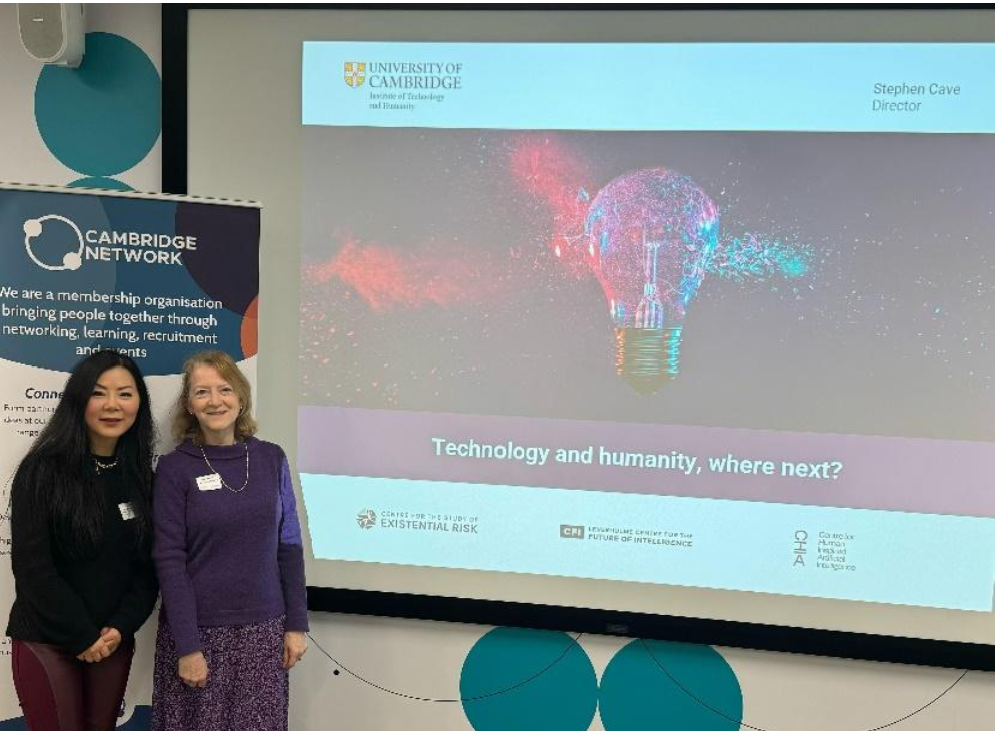
CEO Lily Lin (EFEC) and executive Director Claire Ruskin (Cambridge Network)
at the Cambridge University Institute of Technology presentation hosted by The Cambridge Network
This week, as an excellent demonstration of how this happens, Cambridge Network hosted Dr Stephen Cave, CEO of the Cambridge University Institute for Technology and Humanity, who gave an inspiring talk on ‘Technology and humanity – where next?’.
The Institute for Technology and Humanity brings together the Leverhulme Centre for Future of Intelligence, the Centre for Human AI and the Centre for the Study of Existential Risk.
This enables a focus on what can be beneficial, what are the risks and what can be done to secure the goods and avoid the bads of very rapid technological change.
And the changes are very rapid – ‘exponential’ is an accurate description, given the scope, pace and nature of the changes we are living through today.
The questions that the Cambridge University Institute for Technology and Humanity is addressing are vital to our futures. The Institute of course works with others around the world with the dame questions in focus.
Major revolutions in technology are always disruptive. The first Industrial revolution for example led to an utter transformation in human prosperity, but also to inequalities, pollution, wars…
As with Industrial Revolution 1 (steam power and factories), so, to some extent, with IR 2 (rail and telegraph), IR 3 (digital) – and our age, IR 4 (cyber-physical systems).
The big distinction in this age is pace of change as much as scale and this wets some real risks that could, if let be, lead to
- economic inequality
- sudden vast shift in power dynamics
- externalities and environmental impacts
- wars
So, we need to act. The main routes to the better world we could have would seem to be via responsibilities being taken at all levels – from engineers who enable new tech via corporations and Government, through to sustained international governmental co-operation, regulating and governing the new world.
And the EFEC part of that new world is to continue to support Cambridge – Lingang co-operation via our work with both Cambridge Network and Lingang Cambridge Network.